Friday, February 18, 2011
Russia, Japan and the Kurils Faceoff
Russian President Dmitry Medvedev caused a stir late last year when he became the first Russian leader to set foot on the Kurils. Now he's making waves again by declaring that Russia will deploy “modern” weapons to defend the Kurils which he then went on to claim were “an inseparable part” of Russia. His comments came just after February 7, which is Northern Territories Day in Japan, a day when the Japanese annually assert their claims of ownership over the four islands seized at the end of World War II.
A bigger question is why the two nations are engaging in such a high-profile spat over these islands in the first place. Of course ownership of them also gives one country of the other the right to use the rich fishing grounds around the islands and to explore the seabed for potential deposits of natural gas. But the dispute also threatens to derail Russo-Japanese relations; the two countries recently signed a joint deal to build a Liquefied Natural Gas (LNG) plant on Russia's Sakhalin Island to supply Japan with natural gas, Russia also expects Japan to be a market for Siberian crude oil once their East Siberia Pacific Ocean (ESPO) pipeline becomes fully operational in 2013.
Past the mineral wealth attached to the Kurils, the reason for the dispute over the islands seems to be more tied up with notions of national pride more than anything else. Writing in the Moscow Times, author Richard Lourie argues that in addition to controlling the mineral wealth the islands may or may not contain, Russia wants to keep control of the entire Kuril chain since that bit of territory completes the encirclement of a remote branch of the Northern Pacific known as the Sea of Okhotsk – you may have heard of this body of water (probably the only reason you've heard of this body of water) was because of last month's operation by the Russian Navy to rescue four icebound fishing trawlers, which gives you a pretty good idea of what life is like on the Sea of Okhotsk. Without being encircled by Russian territory, it could be argued that the Sea of Okhotsk was an international body of water, something Moscow apparently does not want. For Japan, the Kurils are the second island dispute they've been involved in during the just past year alone. The other was a faceoff with China over a collection of rocks in the South China Sea that the Japanese call the Senkakus and the Chinese call the Diaoyutai. That dispute led to a collision at-sea between Japanese and Chinese boats and a strong-arm Chinese embargo of rare earth elements to Japan (rare earths are vital in the production of a host of high-tech goods, which are the cornerstone of the Japanese economy).
With Russia's President Dmitry Medvedev looking to burnish his tough guy credentials in the light of his ruling tandem buddy, the International Man of Action, Vladimir Putin, and with the Japanese not wanting to lose face, again, over an island dispute, both sides seem set to dig in their heels over the Kurils, even if it makes as much sense as bald men fighting for a comb.
Thursday, September 30, 2010
Peace At Last! World War I Finally Ends
Some great news out of Europe – the First World War, a conflict so horrible it was known as the “war to end all wars” is finally officially ending 96 years after it began.
And no, you didn't miss 90 years of history, the fighting actually did end in 1918 and the conflict officially came to a halt in 1919 with the signing of the Treaty of Versailles. But that treaty also stipulated that Germany pay war reparations, primarily to Belgium and France; on Sunday Germany will make the last of those payments with a sum of approximately $93 million, finally satisfying the conditions of the Treaty of Versailles and “officially” ending the war.
As a condition to the treaty, France and Belgium demanded enormous sums of money as reparations from Germany, about 226 billion Reichmarks in 1919. John Maynard Keynes, Britain's top negotiator at the time, was so outraged at the sum that he walked away from the peace negotiations and warned that Germany wouldn't be able to properly recover from the war themselves if they had to payout so much of their national treasury to France and Belgium, a condition Keynes said would lead to future problems. Those future problems turned out to be World War II. The huge debt payments did, as Keynes predicted, bankrupt the German state in the 1920s; which led to the rise of Hitler and the Nazi Party. The rest, as they say, is history.
The German payment will go towards paying off bonds issued after the end of the conflict against the payments Germany owed to the Allied nations, most of those bonds today are held individuals or organizations like pension funds. And in case you’re wondering, officially World War II isn’t over either – at least as far as Russia and Japan are concerned, the two sides have never signed a peace treaty due to a dispute over the Kuril Islands, which Russia occupied from Japan in the final days of the war and continue to hold to this day. North and South Korea have also never signed a peace treaty to formally end the Korean War either.
Sunday, August 1, 2010
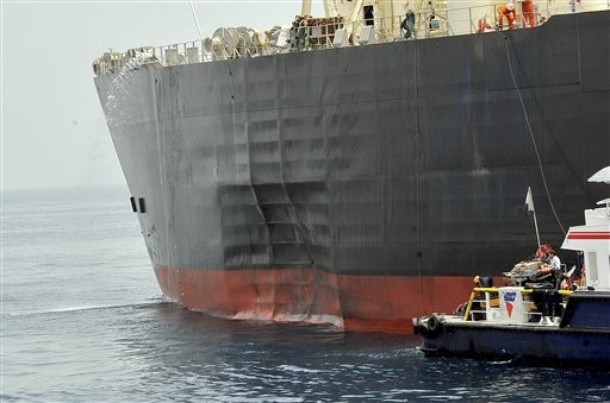
Persian Gulf Monster
And here’s where I think things get interesting. The incident involving the M. Star is exactly the kind of thing you would expect the hawks out there advocating for military action against Iran, due to that country’s alleged nuclear weapons program, to jump on – raising the specter of an Iranian attack against the world’s oil supply, etc (as we’ve learned from the run-up to the Iraq War, the accuracy of such claims is a secondary concern to just getting the claims out there and ratcheting up the supposed need for action against a rogue regime). Yet the hawks have been silent on the M. Star, making me wonder if the tanker didn’t in fact run into another ship, specifically a ship that shouldn’t have been in the Strait of Hormuz in the first place – perhaps a US or Israeli navy ship on a covert mission? Ships from the navies of both nations are reported to be in the region, a fact in itself that has raised the fear of an impending Israeli or US/Israeli strike against Iran’s nuclear sites. There would be a great desire to keep such an incident quiet, since covert operations work best when they’re actually covert. A second possibility being floated was that the tanker did strike another vessel – some damage assessments of the dent say it would be consistent with running into a wooden vessel, like the dhows or fishing trawlers common in the Gulf. The crew of the M. Star could be keeping the real story quiet to keep from implicating themselves in an at-sea collision (of course this raises the question of what happened to the other boat….).It is all speculation at this point though, and it is worth noting here that a mysterious dent appearing in the side of a ship was also the way several of the Godzilla movies started… So until more evidence is found, or someone starts talking, what happened to the M. Star will remain a mystery for now.
Sunday, June 13, 2010
As The Warship Turns…
The Mistral is an amphibious assault ship; its mission is to rapidly deploy several hundred battle-ready troops ashore with their tanks and other heavy equipment and to carry a squad of helicopters to provide air cover for the invading troops. Critics have questioned why Russia – the country with the world’s longest land borders and few overseas possessions – would need amphibious assault ships in the first place. The Russian military didn’t help to quell their neighbor’s fears when a high-ranking general remarked how much more smoothly Russia’s August 2008 conflict with Georgia would have gone if Russia had the Mistral in its arsenal. But last week Russian Armed Forces Staff Gen. Nikolai Makarov gave the official explanation as to why Russia needs to buy Mistrals from France – to protect the Kuril Islands.The Kurils are a chain of rocky, barren islands in the Northern Pacific. In August 1945, Josef Stalin finally made good on a pledge to open a second Pacific front in World War II against the then all-but-defeated Imperial Japan. One of the bits of territory snatched by the Red Army in the closing days of the war were the Kuril Islands. Sixty-five years later, the Russians are still there, while Japan is still demanding the return of the four southernmost Kurils – a small dispute that has actually kept Japan and Russia from signing a peace treaty to formally end World War II. The dispute over the Kurils brings to mind an old joke about the British-Argentine war for the Falkland Islands: that it made as much sense as two bald men fighting over a comb.
It’s hard to believe the Russians would look to spend $2 billion to buy four Mistral warships to guard against a hypothetical invasion over a collection of wind-blown rocks… Russia’s interest in the Mistrals actually has less to do with the ships themselves and more to do with the technology inside them. In terms of technology, Russia’s military is lagging behind their NATO counterparts, particularly when it comes to integrated command-and-control systems (ones that link together satellite imagery, GPS coordinates, the ability for soldiers to communicate with HQ, etc). These weaknesses were shown during Russia’s 2008 conflict with Georgia. The Mistral, meanwhile, is also a command-and-control hub for the troops it sends ashore. So buying a Mistral from France would give Russia direct access to this state-of-the-art technology; building Mistrals in Russia under license (the deal Putin is pushing for) would give the Russians even more hands-on experience with these systems.
The United States has been pressing France not to make the Mistral deal, precisely for this reason (which is a bit odd since we’re all suppose to be friends now). But France has shown a willingness recently to sell their technology as a way to make big arms deals. Brazil is looking to upgrade their air force and is considering bids from the United States, Sweden and France. Only the French bid though is willing to include a transfer of key technology to Brazil as part of the deal. It remains to be seen if France is willing to cut Russia the same bargain regarding the Mistrals. One sign of how much Russia wants this agreement to go through is a separate offer made by Putin during his visit to allow France’s petroleum firm Total SA bid for a 25% stake in a Siberian natural gas field – Putin has long been a strong proponent for keeping Russian natural resources in Russian hands.
Thursday, May 27, 2010
Japan’s PM Sparks Fashion Row
The rise of Yukio Hatoyama to the role of Prime Minister seemed to signal a seismic shift in Japanese politics last year, ending nearly a half-century of Conservative rule in the country, but now even his choice of shirts is drawing criticism from the Japanese public. At issue now is the multi-color check shirt that he recently wore to a barbecue (pictured at right), one Japanese designer even asked: “is anyone able to stop him wearing such a thing?” It’s worth noting though that a Shanghai-based retailer is selling copies of the infamous shirt at $500 a pop, so someone must like them.On a more serious note, Hatoyama’s ruling coalition may be in big trouble, as he seems ready to allow the United States to maintain a massive military presence on the island of Okinawa. The US Marine Air Station has long been a sore point for Okinawans who complain about the noise and pollution generated by the base and the crimes committed on the island by off-duty Marines, which they feel often go unpunished. Hatoyama had caused a diplomatic row with the United States earlier this year by seeming to support a call from his coalition partners in the Japanese government, the Social Democrats, who want the base removed from Okinawa entirely. Now, Hatoyama seems willing to just allow the base to be moved from one part of Okinawa to another less-populated area. The Social Democrats are outraged by what they feel is a betrayal from Hatoyama and are threatening to pull out of the coalition, which would cause Hatoyama’s government to collapse. But with recent aggressive moves by North Korea, including the sinking of a South Korean naval vessel, Hatoyama likely feels he’s not now in a position to weaken the US-Japanese military alliance, even if it winds up costing him his job.
Thursday, August 6, 2009
Americans Still Favor The Atomic Bomb
The Quinnipiac poll finds men, Republicans and those over-55 favor the use of the A-Bomb more than women, Democrats or people under 35, going further into the data, the only demographic to say using nuclear weapons was wrong were Blacks, 36% to 34% who said it was the right thing to do. Hispanics supported the use of the bomb 44% to 43%.
Americans still feel that the nuclear bombing of Hiroshima and Nagasaki saved lives. The US military had plans on the table for a 1946 ground invasion of Japan, but they thought it would be incredibly costly - with American casualties of perhaps more than 100,000, while casualties among the Japanese (military and civilian) were projected into the millions. There is also a train of thought though that suggests another reason for using the nuclear bomb was to send a none-to-subtle message to the Soviet Union about how power in the world would be divided once the war was finally over (though the Soviets developed their own bomb just a few years later).
While 61% is still a solid majority, it is a drop from the 85% approval rate that pollsters found among Americans shortly after the war.
Thursday, July 2, 2009
Was North Korea 'Weapons Ship' A Hoax?
The test wasn't a total surprise since North Korea has been telling ships to stay out of a part of the Sea of Japan where the missiles landed for the past two weeks. With the Fourth of July coming up on Sunday, and North Korea acting rather belligerent these days, there's been speculation that they might mark the day with the test of a long-range missile that they claim could reach Hawaii. North Korea used the Fourth of July in 2006 for the (failed) test of a Taepodong-2 ICBM, along with a brace of smaller rockets. But intelligence officials haven't seen the kind of activity that usually goes along with a North Korean long-range missile launch. The last Taepodong-2 test this past April, (another failure) came after two months of preparation.
Meanwhile mystery continues to surround a North Korean cargo ship. Officials first worried that the Kang Nam 1 was carrying material from North Korea's suspected weapons of mass destruction (WMD) program, then it was thought the ship was hauling conventional weapons to Myanmar (formerly known as Burma) in violation of a UN-backed embargo of the country. Some US officials, like Sen. John McCain, argued for the US Navy intercepting the Kang Nam 1 to inspect it or force into port before reaching Myanmar (after North Korea's April missile test, the US, Japan and South Korea said they would reserve the right to stop any ships they thought were carrying WMD technology as a type of sanctions against North Korea).
But now the ship has apparently turned around, prompting "unnamed officials" from the Obama administration to wonder if the whole voyage of the Kang Nam 1 wasn't an elaborate scam by North Korea to draw the United States (or Japan or South Korea) into an international incident where they would force the ship to stop only to find that it was carrying some benign cargo, making North Korea look like the victim of some conspiracy against it in the process.
The Kang Nam 1 is currently off the coast of Hong Kong.
Tuesday, April 7, 2009
North Korea, 0-for-2 in missile launches
Of course this didn’t stop North Korea from claiming that the launch was a total success and for alleging that even now the satellite Kwangmyongsong-2 is circling the Earth, broadcasting patriotic hymns to North Korea’s Kim Jong Il and his father Kim Il Sung. Nor did it stop Dear Leader Kim from hailing the rocket’s “successful” launch, while, according to the North Korean state news agency, saying he “felt regret for not being able to spend more money on the people’s livelihoods and was choked with sobs.”
Uh-huh…I mean Kim could have spent money on feeding his nation’s starving citizenry, but why do that when there are dud rockets to launch?
Of course the whole reason Kim had the State sink untold billions into the Taepodong-2 project was to provoke exactly the type of response that he got from the world community. The launch was roundly condemned as a provocation by just about everyone, while the United Nations met in an emergency session to discuss what to do next about North Korea and the troublesome Kim. And, of course, right wing pundits and politicians in the United States took President Obama to task for not doing enough to stop Kim and for leaving the United States “at-risk” of North Korean nuclear attacks.
This, frankly, is a wild overstatement of North Korea’s abilities. So far North Korea’s nuclear ICBM program has consisted of two failed rocket launches and one dud nuclear weapons test, hardly a fearsome program. But this doesn’t stop some from presenting North Korea as an existential threat to the existence of the United States (including this gem from Neo-conservative spokesman Frank Gaffney, who takes a turn into science fiction by insisting that North Korea will not only develop a working ICBM, but also an electro-magnetic pulse [EMP] weapon that will destroy all of America’s electronics, plunging us back into the Stone Age).
So what to do about North Korea? My idea – nothing. Talk of more sanctions on North Korea were scuttled by China and Russia at the UN, mostly by China which fears that if the government in North Korea collapses, they’d have millions of starving refugees showing up on their border. Knowing this Kim has in the past used weapons test to scare the world community into concessions to North Korea on foreign aid to prevent him from developing more weapons (which he’s usually just gone ahead with anyway).
Knowing this, then perhaps the best move would be to do nothing, to basically ignore the Taepodong-2 test, realizing that as a weapon of war the Taepodong-2 is useless. Not only does it take months to get ready to launch (more than enough time to destroy one on the ground), it doesn’t work once it is fired. Maybe if we move away from the fear-based negotiations scheme with North Korea, it will open a path for a new kind of relations with the world’s most reclusive nation.
Thursday, March 26, 2009
Why not to worry about North Korea's missile test
The thought of North Korea, the secretive Stalinist state led by the odd Kim Jong-Il, possessing a missile that could reach the United States is a scary idea – the reality of the situation though, isn’t. The Taepodong-2 missile failed in its first, and so far only test, and getting the missile ready for launch has already taken the North Koreans two months – not exactly something you can fire off in a surprise attack.
That’s not to say there isn’t a lot of tension surrounding North Korea these days. Last year, the world thought for awhile that Kim Jong-Il was dead though now it’s widely believed that he had a stroke and spent months recuperating; there’s now talk of a struggle among North Korea’s upper echelon to become the Dear Leader’s designated successor. Relations between North and South Korea have sunk to a low point not seen in years, and Japan is threatening to make North Korea’s Taepodong-2 missile test also a test of their anti-missile interceptor system.
North Korea says that the Taepodong-2 is meant to carry a satellite into orbit, which is reminiscent of the Soviet Union’s launch of Sputnik, the world’s first artificial satellite, back in 1957. Sputnik’s launch was not only a propaganda coup for the Soviet Union, but it was also a bold way of telling the United States that their R-7 missile could carry a nuclear warhead from the Soviet heartland straight to the US. The launch quickly spurred talk of a “missile gap” between the US and Soviet Union (that really didn’t exist) and sparked an arms race as the US tried to ‘catch up’. Luckily for the Soviets the US didn’t know just how long it took them to get an R-7 ready for launch, a process that included a full day just to load the missile with fuel – making it basically useless as a weapon of war.
The North Koreans don’t have the luxury of satellite-free skies though; intelligence agencies around the world have been able to follow the many weeks of preparation they’ve put in to getting the Taepodong-2 ready to fly. If the Taepodong-2 were being readied during a time of war, there would have been ample time to destroy the thing on the launch pad, long before it ever flew.
The Taepodong-2 isn’t an effective weapon, whether its an effective propaganda tool depends on whether or not North Korea’s neighbors and other interested parties (like the United States) allow them to once again use threats of military force as a bargaining chip in negotiations to provide aid and lift sanctions against North Korea that have dragged on for years.
Wednesday, March 25, 2009
A survivor's tale from Japan
Back in 1945 Mr. Yamaguchi was a businessman visiting the Japanese city of Hiroshima on August 6th, the day the United States dropped the atomic bomb. Yamaguchi survived the attack with severe burns and set out the next day for his home - Nagasaki. He arrived just in time to experience the nuclear bombing of that city on August 9th.
The Japanese government has now finally certified the 93-year old Mr. Yamaguchi as the only known survivor of both atomic bombings. Mr. Yamaguchi hopes that his status will enable him to tell younger generations about the horrors of atomic weapons.
Wednesday, February 4, 2009
And Starring Dick Cheney as Dr. Strangelove...
Not even a month into the tenure of Pres. Barack Obama, Cheney is making noise about the threat posted to America by terrorists, specifically terrorists packing nuclear bombs, chemical or bioweapons, and then warning about how Obama isn't taking the threat (well, his threat) seriously enough.
Of course the idea of a terrorist with a nuclear bomb is, well, terrifying. But it’s also something a lot more suited to the Tom Clancy’s and Jack Bauer's of the world than to reality. The simple fact is that of all the mass casualty terror attacks this decade - from 9/11 through London, Madrid, Moscow, Beslan (the school massacre in Southern Russia), Bali, right up to Mumbai late last year, none have involved anything more sophisticated than knives, AK-47's and home-made bombs. Why? Because we have seen that those simple things, when wielded by dedicated attackers, can bring a country to its knees.
So in the terrorists’ grisly cost-benefit analysis, WMDs just aren't worth it. Why spend millions of dollars and years of intense effort trying to acquire an a-bomb or a bioweapon when a box cutter will do just nicely? And there's the small matter that WMDs are damn finicky things. North Korea spent years and billions of dollars, turning itself into a pariah state in the process only to produce a nuclear dud (a "fizzle" in technical jargon). Aum Shinrikyo, the Japanese doomsday cult, unleashed a Sarin gas attack on a Tokyo subway (Sarin is one of the deadliest nerve gases out there), yet only killed 6 people.
WMDs are tricky, expensive things that in the hands of a novice are more likely to kill the attacker than the attackee. But this doesn't stop us from scaring ourselves silly over the idea of terrorists using them.
And that gets back to Cheney. With the Bush Administration legacy in tatters, why not try to scare people about the new guy? Comments like this coming from Cheney though are about as believable as Dr. Strangelove warning about the mineshaft gap with the Soviets (go see the movie, you'll get the reference).
Saturday, January 31, 2009
A-pirating again
At the end of 2008 the Navy announced the creation of Combined Task Force 151, a unit dedicated to fighting piracy in the Gulf of Aden, joining the navies of more than a dozen other countries from around the world operating off the coast of Somalia. After boom times earlier in the year that at one point saw the pirates holding nearly three dozen ships, successful hijackings fell to just a handful in December. Task Force 151's commander, Rear Admiral Terry McKnight, thinks the US has been a decisive factor in the drop.But as Wired magazine's ‘Danger Room’ blog points out, the US Navy hasn’t actually ever engaged any pirates - unlike the navies of countries like India, Germany and Russia. And even Rear Adm. McKnight notes that the weather might be as big a factor in the drop in attacks as the presence of the US Navy, noting that the pirates’ boats tend to be small fishing craft, not suited for heavy weather and rough seas. “When the weather picks up, they tend to stay at home, and not out here,” McKnight said in a recent conference call. So much for being a decisive factor.
In fact, hot on the heels of McKnight's press conference, the pirates did land their first major prize of the year - a German tanker the MV Longchamp, which is believed to be carrying a cargo of gasoline. The pirates used a bit of trickery to catch the tanker, first launching an attack on another ship to draw naval vessels in the area away from the Longchamp, which they were then able to quickly board and capture. The German tanker's crew is reported to be okay, and will now likely be held along with their ship for ransom (the Somali pirates are estimated to have made $50 million last year from this cargo ship catch-and-release process).
And another navy is now looking to get in on the action off Somalia. Japan announced that they would be sending one of their destroyers to join in on the international patrols, though Japan will have to amend the law to allow the ship to go. Under the post-war constitution the United States wrote for Japan while we were occupying them after their surrender, Japan's military can only act in self-defense, so, technically, the Japanese ship could only respond if the pirates attacked either a Japanese-owned vessel, or one with a Japanese crew. Prime Minister Taro Aso is planning to introduce an amendment to the law to let their navy engage pirates attacking any ship.
Japan appears to have decided to send their navy to Africa after China sent two warships to the region last month, the first time in modern history that the Chinese Navy has operated away from their home waters.
Wednesday, September 10, 2008
Something familiar in Japanese campaign
Yuriko Koike, a former defense minister, has launched a bid to become Japan's first female Prime Minister. Her reason for running? That because of her outsider status she is the only one capable of bringing the kind of change that Japan's government needs.
"In American terms, I am not much of a Washington insider," she said in an interview with Reuters. "I can make decisions that need to be made," said Koike, "the 'Old Boys club' can't do that. That's what has delayed change in Japan." The last two Prime Ministers have been forced to quit after failing to break the deadlock of a parliament divided between rival political parties. This leads some political observers to think that there might be a shake up of the political parties, with factions splitting off to form new alliances. Koike said that she would be best suited to put together a new ruling coalition.
Koike, meanwhile is playing down any comparisons to Republican Vice President candidate Sarah Palin, but in another odd parallel to our own election, one of the other candidates for the PM spot in Japan, Ichiro Ozawa, is running on a platform of "the people's livelihood first". Kinda sounds like the Republican's tagline "Country First", doesn't it?