Showing posts with label Gulf States. Show all posts

Friday, September 14, 2012

CNN Charged With Censorship Over Mid-East Documentary

Last week media critic Glenn Greenwald of the UK's Guardian newspaper/website published a pair of hard-hitting articles aimed directly at CNN that received surprisingly little coverage in the United States given the severity of their charges, namely that CNN is engaging in acts of censorship to protect the patronage paid to them by foreign governments.

Greenwald's charges center around a documentary made last year about the democratic uprisings in the Persian Gulf state of Bahrain called “iRevolution: Online Warriors of the Arab Spring”.  The documentary, which Greenwald describes as “unflinching”, centered on pro-democracy activists in the tiny kingdom and was highly critical of the heavy-handed government response, which ultimately put down the democratic uprising.  The Bahraini regime was criticized internationally for their methods, which included the mass arrests of protesters (including doctors who were attempting to help injured demonstrators) and the use of deadly force against unarmed and peaceful protesters.  The CNN documentary crew themselves were even detained at gunpoint by pro-regime forces intent on disrupting their attempts at telling the story of the pro-democracy activists.

“iRevolution: Online Warriors of the Arab Spring” would go on to garner critical praise along with a number of journalism awards. Yet despite this praise, CNN's domestic network would air the documentary only once, while CNN's international broadcasting arm, CNNi, the outlet for which “iRevolution: Online Warriors of the Arab Spring” was originally produced, would not air the documentary at all.  The lead journalist on “iRevolution”, Amber Lyon, complained to CNN's upper management about the network's refusal to air the documentary.  Despite being groomed by CNN to become one of their star on-air personalities, Lyon was laid off by CNN earlier this spring after her complaints about CNN's internal censorship became public.

CNN, of course, has denied any attempt at censorship, noting that they have aired many stories about the uprising in Bahrain (just not “iRevolution” apparently).  But it is here, and in a companion piece, that Greenwald lays out his most serious charge against CNN – that CNN has entered into a number of paid partnerships with governments around the world and that CNN is allowing these partnerships to color their reporting from and about these countries.

The CNN “partnerships” with the governments of countries like Kazakhstan, Georgia and Bahrain has led to the production of a series of quasi-journalistic fluff pieces: reports that are meant to look like genuine CNN reporting – using CNN journalists/personalities - but that in reality are public relations spots that allow the “partner” countries to put their best foot forward, with no contrasting viewpoints offered by CNN's stable of journalists. For example, a series of paid reports aired under the “Eye on Lebanon” banner were touted by Lebanon's Tourism Minister not for their journalistic merit, but rather as a way “to market Lebanon as a tourism destination.”   

It's not surprising then to note that CNN has a long-standing partnership arrangement with Bahrain though the Bahrain Economic Development Board, the governmental agency responsible for promoting Bahrain to the world. CNN has included Bahrain in their “Eye on...” country series, among other paid-for network programming. It is not surprising then that CNN has been reluctant to air a documentary that is so critical of the Bahrani royal family.

There is an inherent tension between advertising and journalism, with the open question always being if the news organization will shy away from coverage that could reflect negatively on their sponsors.  But what Greenwald describes at CNN is something different, the countries in question aren't merely buying commercial spots on CNN, they are, in effect, directly paying for positive coverage of their countries. Worse still, the shelving of “iRevolution” and the subsequent dismissal of Amber Lyon is troubling evidence that CNN is willing to let these sponsorships affect their journalistic judgment beyond the paid-for beauty spots.  It is a troubling accusation to make against what has long been one of the most-trusted names in modern journalism, and is a sign of how far CNN has fallen from their own glory days.
Sphere: Related Content

Monday, September 12, 2011

The Saudis' Stark Warning

While the United States was otherwise absorbed in a day of self-reflection over the 10th anniversary of the 9/11 attacks, an influential member of the Saudi royal family issued a stark warning that the long-standing US-Saudi love affair may soon come to an abrupt end.

That was the take-away from Turki Al-Faisal's Op-Ed in yesterday's New York Times, over why the United States should not oppose the creation of an independent nation of Palestine. The Palestinians are widely expected to use the United Nations General Assembly meeting later this month to put a formal end to talks with Israel, unilaterally declare their independence and petition the United Nations for full membership; the United States is also widely expected to use their veto the UN Security Council to squash Palestine's bid for membership on behalf of Israel. Al-Faisal warns though, that such a move would make the United States “toxic” in the Arab/Muslim world, and that this would force the Saudis to then drastically scale back their cooperation with the US and to pursue “a far more independent and assertive” foreign policy in the region. Al-Faisal goes on to say that this would result in Saudi Arabia not formalizing relations with the fledgling government in Iraq, parting ways with the United States on Yemen and suggesting it could lead Saudi Arabia into direct conflict with Iran, among other possible outcomes.

Two things make this more than just the ramblings of another dreary government official in the editorial pages. The first is Turki Al-Faisal's position within the Saudi hierarchy: he is both the former head of the Saudi intelligence services and former ambassador to the United States, roles that have made him the usual go-to guy to do the rounds in the American media when the Saudis want to announce a shift in policy; the second is the overall bluntness of his op-ed. Typically writings like these are couched in diplomatic language, which is vague enough to allow for just about any possibility, Al-Faisal was much more definitive: this will happen, this decision will have that effect, and so-on.

Given the speaker and the tone, it is a message that Washington should take to heart, though it is a pretty safe assumption that they won't.
Sphere: Related Content

Wednesday, July 6, 2011

Secret Pirate Island

Just when I was thinking that I hadn't written about the Somali pirates in awhile, two news stories cross the wires and that all changes.

The first is a detailed account from Reuters that pirates from Somalia are taking advantage of the chaos surrounding the months-long ongoing revolution in Yemen to turn an island off their coast into a secret pirate lair. It shouldn't be a surprise: The island of Socotra – smack in the middle of the Gulf of Aden and on the sea-lane approaches to the Red Sea and Suez Canal – has for centuries been a hideout for Arab pirates plying these waters; for their part, Somali pirates have become masters at exploiting holes in security to enable their operations. According to Reuters, Somali pirates have turned Socotra into a refueling depot for their missions, taking advantage of the Yemeni military's being distracted by the unrest roiling their country as people continue to protest in an effort to unseat the very unpopular President Ali Abdullah Saleh, who is currently recovering from an assassination attempt in Saudi Arabia. In fact, there are some indications that Somali pirates are simply bribing the Yemeni garrison on Socotra to look the other way while they conduct their pirate missions.

The use of Socotra is part of a shift in tactics by the Somalis. When the world first started paying attention to the problem of Somali piracy, many of the attacks occurred near the coast of Somalia. But as a loose coalition of the world's navies started patrolling off the coast and merchant ships started sailing further out to sea, the pirates too adapted. Most attacks now come not from small motorboats sailing from the Somali coast, but rather from speedboats launched from “motherships” - typically a captured fishing trawler or small freighter. But ships of this size burn a lot more fuel than a speedboat, which appears to be how Socotra fits into the picture. By refueling at Socotra, 150 miles out to sea, the pirates' range is drastically increased, allowing them to attack ships far out in the Indian Ocean.

And speaking of burning, that brings us to pirate story #2. Bloomberg is reporting that a large oil tanker is now burning off the coast of Yemen, thanks to a failed pirate attack. The 900-foot, China-bound Brillante Virtuoso was reported adrift and ablaze on Wednesday following an apparently failed pirate attack. The tanker was not said to be at risk of sinking, exploding or leaking since the fire was located in the accommodation block – the building-like structure on deck where the crew lives. The fire did force the crew to abandon ship, they were later rescued by a UN Navy destroyer and the Brillante Virtuoso put under tow, headed for Yemen. It is unclear at this point whether the ship accidentally caught fire during the attack or if the pirates deliberately set the ship ablaze when it appeared that they would not be able to capture it.

According to the London-based International Maritime Bureau, the average ransom payment paid out for the release of a captured ship last year was $5.4 million, making piracy a very lucrative business.
Sphere: Related Content

Tuesday, April 26, 2011

The Real Price Of Oil...

There's an incredibly thought-provoking piece out now from Time.com's military-focused blog Battleland on United States policy in the Persian Gulf. It talks about an analysis put together last year by Roger Stern, an economic geographer at Princeton University, who, after an exhaustive study, calculated the cost of the United States' military presence in the Gulf from 1975-2010 - a cost he puts at a whopping $8 trillion. Yes, that's trillion with a “T”. According to those calculations, the United States now spends as much each year ensuring that the oil from the Persian Gulf keeps flowing as it did in fighting the Cold War. And to make matters worse, Stern argues that it is not money well spent.

US policy towards the Gulf boils down to this: Thanks to the bottleneck created by the Straits of Hormuz, a military force could conceivably block the narrow shipping channels, cutting off the supply of oil and sending the world into an oil-fueled economic shock; therefore we must maintain a robust presence in the region to ensure that this does not happen (the US Navy's Fifth Fleet is currently based in the Gulf kingdom of Bahrain). Stern thinks this is nonsense. While it is conceivably possible that the Straits of Hormuz could be blocked by strategically sinking a few very large ships, the states of the Persian Gulf are too reliant on oil exports to ever do this, and countries outside of the Gulf (like China) are too dependent on oil imports ever to do it either.

History shows that Stern is probably right. Iran and Iraq spent eight years in the 1980s engaged in a brutal war with each other that featured, among other things, ballistic missile strikes on each others cities, the use of chemical weapons and suicide attacks carried out by children on the Iranian side. Yet neither the Iranians or Iraqis ever seriously tried to shut down the Straits of Hormuz, and oil prices were not only largely stable during the period of the war, they were also at near historic lows. If the Straits weren't shut down during that conflict, it is hard to imagine when they ever would be.

Yet much of current US foreign policy is built around just this scenario. Stern argues that this leaves the US overfocused on the Middle East while ignoring strategic threats in other parts of the world – say from China. I absolutely agree with him, especially since this is a point I've been arguing here for some time now. Consider for a moment that by the middle of this decade the United States will likely get as much oil from Africa as from the Persian Gulf, yet our investment/interest in Africa pales in comparison to our focus on the Mid-East. Unfortunately for as compelling as Stern's arguments are, they're not likely to change the minds of many decision-makers in Washington; his report originally came out in April 2010, a full year ago, to little public notice.
Sphere: Related Content

Thursday, March 3, 2011

Saudis Own Protests Coming?

Mark March 11 down on your calendars. That's the day that activists on Facebook are calling for Saudi Arabia's own “Day of Rage” public protests. Their demands seem quite reasonable, they include: an elected, representative body in the government, an independent judiciary, a minimum wage of $2,700 (plus increased employment opportunities for young people) and the “abolition of illegal restrictions on women.” It may not sound like a lot, but in many ways Saudi Arabia is still run like a feudal monarchy and their lack of rights for women has long been a sore point with the international community; and despite being awash in oil revenues, average Saudis complain that wages are low and employment opportunities few for people who are not members of the enormous royal family, the House of Saud.

While protests have been sweeping the Arab world, whether they can actually take hold in Saudi Arabia is still an open question. The experts I know on the region seem doubtful, and according to Reuters, while several hundred people have become fans of the Saudi Day of Rage Facebook page, it is impossible to tell whether they are even in Saudi or not. And unlike Gadhafi and Mubarak, King Abdullah is making efforts to get out in front of the discontent brewing in his kingdom by announcing billions of dollars in public sector aid, in an attempt to quell any public displeasure.

Stay tuned for March 11.
Sphere: Related Content

Friday, February 11, 2011

Somali Pirate Double Shot

This was perhaps the best week ever for the pirates of Somalia as they seized not one but two loaded oil tankers in the Indian Ocean. On Tuesday a pirate crew captured the Savina Caylyn, an Italian-owned tanker heading from Sudan to Malaysia, 800 miles off the coast of Somalia; on Wednesday another crew took control of the Greek-owned Irene SL, which was carrying two million barrels of crude oil from Kuwait to the United States. No casualties were reported in either incident and both tankers are now assumed to be headed to the Somali coast where they will be held for ransom. Somali pirates have captured a supertanker once before, the Saudi-owned Sirius Star, which was eventually ransomed for $3 million.

Pirates have been more active in recent weeks, following a pattern established over the past few years that sees an uptick in pirate activity after the start of the new year and the end of the monsoon season in the Indian Ocean region. The threat of pirate attacks has been a risk that shipping companies traveling in the Indian Ocean have had to deal with for the past several years, but the seizure of two oil tankers on consecutive days could signal an escalation of the problem according to the firm that owns the Irene SL. “The hijacking by pirates of 2 million barrels of Kuwaiti crude oil destined for the U.S. in a large Greek tanker in the middle of the main sea lanes coming from the Middle East Gulf marks a significant shift in the impact of the piracy crisis in the Indian Ocean," said Joe Angelo, the managing director of INTERTANKO, owners of the Irene SL, in an interview with Reuters. While a multinational flotilla of naval vessels is engaged in anti-piracy operations off the coast of Somalia, there is simply too much open ocean (several million square miles depending on how you count the pirates' range) to effectively cover, most of the flotilla's efforts have been in protecting the Gulf of Aden along Somalia's north coast, which is the gateway to the Red Sea and Suez Canal. Navies have also been extremely reluctant to engage in rescue operations once a ship is captured for fear of harming the captured ship's crew; one notable exception was last month when South Korean marines successfully freed the freighter Samho Jewelry, which had been held by pirates for several days.

But for the most part, companies have seen the possibility of paying a ransom for the release of their ship as the cost of doing business in the region. According to the BBC, Somali pirates are currently holding 29 ships of various sizes with an estimated total of 680 crew members among them. Whether the back-to-back tanker seizures changes the equation along the pirate coast remains to be seen.
Sphere: Related Content

Thursday, December 2, 2010

World Cup: Russia, Qatar Win Big

Kudos to FIFA for some bold choices this morning on the sites of the 2018 and 2022 World Cups, which in case you missed it, will go to Russia and Qatar respectively. Though the picks are being roundly criticized in some circles – notably the UK, and to a lesser degree the US, media since each country lost out on their bids to host the Cup - it was nice to see the trend of big, international tournaments going to new parts of the world continue.

I thought that the Russian bid was heading for defeat when Russian Prime Minister Vladimir Putin announced that he would not be traveling to Zurich to make a final, personal appeal to the FIFA committee, but perhaps Putin was just playing coy, acting like he really didn't care if Russia got the cup or not... For Russia the 2018 World Cup will follow on the heels of the 2014 Winter Olympics which will be held in Sochi. Both Putin and President Dmitry Medvedev are talking about how the World Cup shows that Russia has arrived (or perhaps returned) to the level of a “First Nation” country; terms that had previously been used when Russia was awarded the Sochi Games. Even more intriguing is the award of the 2022 Cup to Qatar, which by any measure is a decidedly puny nation – coming in at 164th in the ranking of nations of the world by size and with a total population of just 1.6 million. Of course Qatar is one of the richest (in terms of per capita wealth) nations in the world thanks to huge supplies of oil and natural gas (Qatar has the world's third-largest reserves of the latter). And the Qataris are promising to spend ample amounts of that resource wealth in creating a slate of ridiculously sci-fi looking stadia that they claim will also be “carbon-neutral” for this green 21st century. One interesting aspect of the Qatar bid was their approach to recycling: some stadiums will be dismantled after the Cup and shipped to nations around the world that cannot afford to build such complexes. And while Qatar itself is small, backers of their bid say that the symbolism is huge since this is the first sporting event of global scale to be held in the Islamic world.

Critics are slamming FIFA for the awards though, stating that both countries have lousy human rights records, a factor they say FIFA should have considered in their decision. Some comments on the 2018 Cup questioned how people would get between venues since Russia is such a huge country (covering 11 time zones and 1/6 the world's surface). Russian organizers seem to plan to counter this by staging all of the WC games in cities located in the European third of the nation. Comments on message boards again slammed the Qataris for their approach to human rights, particularly the fact that homosexuality is officially a crime in Qatar; though many of the comments on British sites were complaining that alcohol sales are banned in Islamic Qatar (Qatari officials have pledged to set up special “alcohol zones” for tourists during the games, which should help to satisfy the British drunkards).

And the world now has 11 years to figure out the correct way to pronounce “Qatar”.
Sphere: Related Content

Sunday, September 12, 2010

Kabul's Too-Big-To-Fail Bank

Given the current global recession, bank failures are not particularly newsworthy events.  But the Kabul Bank in Afghanistan is on the brink of being done in not by the economy, but rather by good, old-fashioned corporate mismanagement.  In the past few days, depositors have made a run on the Kabul Bank after infighting between the privately-held institution's two largest shareholders exposed a series of dubious real estate deals made with the Bank's holdings; so far $160 million has been sucked out of the Bank, with estimates of potential losses topping $300 to $400 million – a sum that exceeds the total worth of the Kabul Bank.

The situation is made worse by the fact that the Kabul Bank manages the payroll for Afghanistan's police and military, which puts the institution in that “can't be allowed to fail” category, meaning money to cover Kabul Bank's shortfalls will have to be found somewhere.  Mahmoud Karzai, the Kabul Bank's third-largest shareholder and brother of Afghan President Hamid Karzai (though not to be confused with Hamid's drug-baron brother Wali) has an idea of where that money should come from – the United States.  Mahmoud Karzai thinks a US-bailout of the mismanaged Kabul Bank is just fine, though he, and other Afghan officials, bristle at the idea that the Kabul Bank then be made to adopt basic international management standards for financial institutions – like installing an independent board of directors or allowing audits of the Bank's accounts – or even that anyone be punished for bungling the Kabul Bank to the brink of insolvency.

Afghan officials apparently are worried that any independent look at the Kabul Bank will show that its top stockholders used the rank-and-file deposits to fund lavish lifestyles for themselves, which included some seriously bad real estate deals in Dubai; and as a slush fund for Hamid Karzai's presidential campaign.  The US-bailout deal apparently was being considered by the State Department before thankfully being dropped, on Wednesday, Afghanistan's Central Bank announced that they would step in to provide capital to the Kabul Bank, a good thing since riot troops also had to be called out on Wednesday to manage angry crowds that had gathered outside the Bank's main branch as depositors continue to try to salvage their life savings.

Lost in the shuffle of the Kabul Bank story is the fact that in ten days Afghanistan will be holding national parliamentary elections, elections that international observers fear will be riddled with fraud.  Thanks to the deteriorating security situation across much of the country, there will be fewer polling stations and fewer election monitors than during the country's troubled presidential elections in August 2009  That election saw nearly a million ballots – mostly cast for Karzai – tossed out over suspicion that they were fraudulent, a move that infuriated Karzai.  Speculation is that this upcoming election could see even more fraud committed than in March.

Shady elections, one brother of the country's President allegedly one of the nation's biggest druglords and now another brother a major shareholder in a bank used to fund lavish lifestyles for its top investors; it's the sort of mind-boggling corruption to make you question why after nine years the United States insists on remaining in Afghanistan propping up the same typr of government we condemn in other parts of the world?  Time magazine tried to offer a graphic explanation this summer: since apparently if US forces leave then the Taliban will be free to cut the noses off of young women around the country, just as was tragically done to poor Aisha as her punishment for running away from her abusive husband.

In 2009, when United States forces were already occupying large parts of her country...

Sphere: Related Content

Sunday, August 1, 2010

Persian Gulf Monster

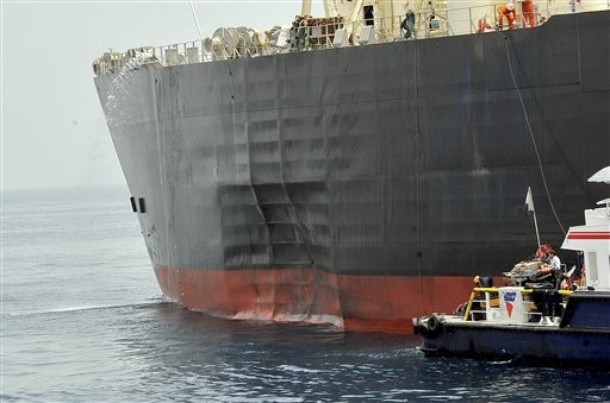
The big mystery out of the Persian Gulf region last week was the question of just what happened to the Japanese oil tanker the M. Star? The tanker was passing through the Strait of Hormuz, near the coast of Iran, when something happened that left an approximately 20-foot dent in the side of the massive ship. The M. Star immediately diverted to the port of Fujairah in the United Arab Emirates, though no one on the ship was injured and the tanker was not reported to be leaking any oil. The initial report was that the damage had been caused by a “rogue wave” (a massive wave that runs counter to normal surface wave patterns), though these reports were quickly dismissed because there were no events – like a massive storm or earthquake – that would generate a rogue wave in the region at the time of the incident. The crew of the M. Star claimed to have seen a “bright flash” just before discovering the dent, raising the possibility that the tanker had been the target of a terrorist attack. But that idea has also been discounted, since experts say the dent in the side of the ship, a near perfect square, doesn’t match up with the expected blast pattern from an external explosive. Rather, the experts say, it looks like the M. Star was involved in a collision.

And here’s where I think things get interesting. The incident involving the M. Star is exactly the kind of thing you would expect the hawks out there advocating for military action against Iran, due to that country’s alleged nuclear weapons program, to jump on – raising the specter of an Iranian attack against the world’s oil supply, etc (as we’ve learned from the run-up to the Iraq War, the accuracy of such claims is a secondary concern to just getting the claims out there and ratcheting up the supposed need for action against a rogue regime). Yet the hawks have been silent on the M. Star, making me wonder if the tanker didn’t in fact run into another ship, specifically a ship that shouldn’t have been in the Strait of Hormuz in the first place – perhaps a US or Israeli navy ship on a covert mission? Ships from the navies of both nations are reported to be in the region, a fact in itself that has raised the fear of an impending Israeli or US/Israeli strike against Iran’s nuclear sites. There would be a great desire to keep such an incident quiet, since covert operations work best when they’re actually covert. A second possibility being floated was that the tanker did strike another vessel – some damage assessments of the dent say it would be consistent with running into a wooden vessel, like the dhows or fishing trawlers common in the Gulf. The crew of the M. Star could be keeping the real story quiet to keep from implicating themselves in an at-sea collision (of course this raises the question of what happened to the other boat….).

It is all speculation at this point though, and it is worth noting here that a mysterious dent appearing in the side of a ship was also the way several of the Godzilla movies started… So until more evidence is found, or someone starts talking, what happened to the M. Star will remain a mystery for now.
Sphere: Related Content

Sunday, June 13, 2010

Are The Saudis Onboard For Israel Air Raid?

An update now to last Saturday’s post: “Israel, Iran and the Summer War”. The Times of London reported on Saturday that Saudi Arabia and Israel have struck a secret deal where the Saudis will basically “stand-down” their national air defense system over the northern part of the country to allow the Israeli Air Force a corridor to fly through on their way to attack nuclear sites in Iran. Rumors of Saudi assistance in an Israeli strike have been circulating for some months now, the Brookings Institution war game scenario of an Israeli raid on Iran even speculated that the Israeli Air Force might set up a secret refueling base in the Saudi desert (the target sites in Iran are at the far edge of the IAF’s operational range).

Since Saddam Hussein’s removal from power, Iran’s influence in the Persian Gulf has grown steadily, thanks in part to now no longer having to worry about getting involved in another war with their long-time adversary, Iraq (the two countries spent most of the 1980s engaged in a bloody, but ultimately fruitless, war). Iran’s growing power has not sat well with the Saudis, who like to see themselves as the big player in the Gulf, which is why they would likely be willing to let Israel use their airspace to launch an attack on Iran. The Times article should be seen as more evidence that an Israeli air strike against Iran this summer is becoming more and more likely.
Sphere: Related Content

Monday, January 18, 2010

Should We Leave The Persian Gulf?

I tend to be hot and cold on the works of Thomas Friedman – he sometimes makes good points, but they’re rarely the revelations he portrays them to be. His latest column in the New York Times “What’s Our Sputnik?” though got me thinking.

In it Friedman questions America’s deep involvement in the Middle East – he argues that the money we are spending on anti-terrorism could be better spent in developing alternative sources of energy that would make us less dependent on the Mid East, meaning we could lessen our engagement with the region, which would in turn – he argues – would make us less a target for terrorists based, funded or inspired by sources in the region.

There is a certain logic to his argument, but it made me think of something else. In his column, Friedman notes that our two largest foreign suppliers of oil are Canada and Mexico. What he doesn’t say is that most estimates are by the middle of this new decade we find ourselves in the nations of Africa will surpass the countries of the Persian Gulf as suppliers of oil to America. So in my mind that begs the question: why should the United States keep dedicating so many of our resources to a region that in just five years will be a third-rate source of oil for us? China is talking about opening a naval base in the Persian Gulf; France is establishing one in the region as well. Maybe then it’s time to let some of the world’s other major oil importers share the burden of keeping stability in that part of the world?

Just a thought.
Sphere: Related Content

Monday, January 4, 2010

China May Build Foreign Military Base

In a sign that China is seeing itself as a growing world power, the Chinese military is discussing building a permanent naval base in the Middle East. It's a move their admirals say is necessary if China is going to continue to participate in anti-piracy operations in the Indian Ocean off the coast of Somalia.

China joined international efforts at curbing piracy last year. The action was a milestone change in Chinese military planning - it was the first time the navy of the People's Republic had operated so far from Chinese territorial waters and the first time naval vessels from China had engaged in a mission to Africa in 600 years, since the time of the treasure fleets of the Ming Dynasty.

China is currently the world's largest importer of oil, much of it from the Persian Gulf and Africa, so a navy base in the region to protect their energy interests makes strategic sense. But it is also a sure sign of China's growing military clout and desire to be a player in matters of international security, desires that are sure to be met with unease by some other world governments.
Sphere: Related Content

Saturday, November 7, 2009

Saudis Battling Rebels Along Yemeni Border

For the past several days Saudi Arabia has engaged in a series of fierce clashes along their southern border with Yemen.

That the Saudi military is actually fighting somebody could be news in itself - an apocryphal story from the first Gulf War was that if Saddam Hussein ever invaded Saudi Arabia, US forces were ordered not to fire at the first troops they saw coming from the border since those would be the Saudis abandoning their posts. This time, the Saudis have taken the offensive against Yemeni rebels from the Zaidi Shiite sect. Yemen's government has accused the Zaidis of trying to overthrow them to restore a religious imamate that overthrew an earlier Yemeni elected government back in 1962, sparking a civil war in the process.

The Yemeni government has fought the rebels for the past five years along the rugged border with Saudi Arabia. Recent cross-border raids by the Zaidis prompted the Saudis to act. The Saudi military has used both aircraft and artillery in a series of intense strikes against the rebels, which began on Tuesday. Details on casualties and even where the fighting is exactly occurring are sketchy - the rebels say the Saudis have attacked inside Yemen, while the Saudis say the military strikes have been limited to their side of the border.

In either case though the Saudis have the support of the Yemeni government, which supports their actions against the rebels. And looming large over the whole situation is Al-Qaeda. Twice in the past three months, Saudi Arabia claims to have foiled terror attacks by a Yemen-based Al-Qaeda affiliate, Al Qaeda in the Arabian Peninsula (or AQAP). According to analysts, the Yemeni government's battle against the Zaidi rebels has left them with little ability or initiative to fight groups like AQAP. In turn, veteran jihadis from Iraq and Afghanistan are said to be moving to Yemen, which along with the largely lawless Somalia, are being viewed by Al-Qaeda as the most likely places to establish a new base of operations.
Sphere: Related Content

Sunday, October 25, 2009

Saudis Take One Step Forward, Two Steps Back

Last month Saudi Arabia opened up a brand new school - the King Abdullah Science and Technology University (or KAUST). The Saudi royal family spent $7 billion to build an ultra-modern center for the sciences, which includes state-of-the-art labs and one of the world's fastest super-computers. But what makes KAUST truly remarkable, for Saudi Arabia anyway, is that within its campus men and women can mix freely, and women can do wild things like go outside without veils and even drive cars - both big taboos in ultra-conservative Saudi Arabia.

The whole point of KAUST is to help diversify Saudi Arabia away from its petro-driven economy by establishing a base for science and technological research. It is also being used as a place to start to breakdown long-standing cultural taboos against the mixing of the genders. Of course as soon as it opened, KAUST became a target for religious conservatives. Sheikh Saad Bin Naser al-Shethri, a member of Saudi's Supreme Committee of (Islamic) Scholars, demanded that women be barred from the university. In a rare blow for women's rights, King Abdullah turned around and sacked Shiekh al-Shethri from his position on the Supreme Committee.

So are conditions for women actually changing in Saudi Arabia? Not really. Just a couple of weeks after this tacit endorsement of women's rights in Saudi, a court in the city of Jeddah ordered that a female journalist receive 60 lashes for having been involved in a talk show that talked about, you know, s-e-x.

Journalist Rozana al-Yami received the sentence after LBC, a Saudi-owned Lebanese television network aired an episode of their popular talk show "Bold Red Line" where a Saudi man named Mazen Abdul Jawad talked about meeting Saudi women and having sex with them. For publicly bragging about "picking up chicks" Jawad was sentenced to 1,000 lashes and five years in jail.

What makes Rozana al-Yami's sentence more disturbing though is that there is no proof she was directly involved in the Jawad episode of "Bold Red Line", only that she worked part-time for the network, which according to the judge made her guilty enough to face the lash. Needless to say al-Yami's verdict is being seen as an attack on both women and journalists, and may also be a message to LBC's owner Prince Alwaleed bin Talal, who is perhaps the most liberal and reform-minded member of the Saudi royals.

No matter how many progressive steps like the opening of KAUST Saudi Arabia takes it means nothing so long as sentences like the one against Rozana al-Yami continue to be handed out.
Sphere: Related Content

Sunday, September 13, 2009

Dubai Goes Metro

Dubai, the oil-rich city on the Persian Gulf that in recent years has engaged in a number of mind-boggling building projects including the Palms artificial islands (built in the shape of palm trees of course) and Burj Dubai, now the world's tallest building, opened another massive project on Wednesday - the Gulf region's first Metro rail system.

The Metro Red Line opened with much fanfare on Wednesday and carried more than 100,000 riders during its first two days of operation (that's nearly 10% of Dubai's total population). Though how many of them were actual commuters and how many were just trying out the latest attraction in a city full of attractions remains to be seen. The purpose of the Red Line though is to relieve traffic in car crazy, and chronically congested, Dubai. Some riders though complained of delays and equipment malfunctions on the line's first day of service, though by Thursday some of the problems had already been corrected.

If you'd like to see what the fuss is about, then check out the video below from one of CNN's "iReporters", who filmed his ride on the line from one end to the other and then sped the video up so that you're traveling about 800mph (keep in mind, the real Metro doesn't travel nearly this fast).

Sphere: Related Content

Thursday, June 18, 2009

Carter Decries Gaza Situation (and cries)

Former President Jimmy Carter visited Gaza on Tuesday and slammed Israel for their treatment of the territory’s 1.5 million residents. Since their conflict with Hamas, who controls the territory last January, Israel has maintained a strict blockade on the Gaza Strip. But this has prevented many Gazans from repairing the thousands of buildings damaged or destroyed by the fighting. The Israeli blockade has been so tight that some Gazans have resorted to using mud to repair their damaged homes (mud historically has been used as a building material in the region so the idea's not all that crazy, we just don't usually think to build mud buildings in the middle of urban areas in the 21st century).

While the Washington Post said that Carter "decried" the Gaza destruction and the Israeli blockade, other media reports said that conditions on the ground moved him to tears. The former president didn't hold back in his criticism saying that the Gazans were being treated "more like animals than human beings", and that "never before in history has a large community been savaged by bombs and missiles and then deprived of the means to repair itself." Carter went on to say that the Israeli blockade has caused many Gazans to rely on smugglers, who use tunnels under the border from Egypt, to survive.

One interesting development - Carter said that Hamas' exiled leader Khaled Meshal, whom Carter met in Syria, told him that Hamas would accept a peace agreement with Israel if the Palestinians approved the measure in a referendum, and if Israel returned to its 1967 borders - leaving the West Bank and Gaza - this now puts Hamas in-line with the pan-Arab peace deal put forward by the Saudis in 2002.

Meanwhile a group of 40 humanitarian organizations, including the UN agency for Palestinian refugees (UNRWA), Oxfam International and CARE all called for Israel to lift its blockade to allow desperately needed humanitarian aid into Gaza.
Sphere: Related Content

Sunday, May 17, 2009

If these places are becoming the 'new Afghanistan', can't we just forget about the old one?

In the past few weeks I've read several analysis pieces claiming that not one, but two countries (Yemen and Eritrea) are vying to becoming the "new Afghanistan" - the new home base for al-Qaeda's terror operations. Meanwhile, Gen. Petraeus, the man leading America's 'War on Terror' stated last week that al-Qaeda's leadership has, in fact, abandoned Afghanistan in favor of Pakistan. And, according to Pakistan's President Asif Ali Zadari, al-Qaeda may very well have relocated without their most famous member, Osama bin Laden, whom Zadari, based on the intelligence reports he's seen, believes is actually dead.

So if al-Qaeda has given up on Afghanistan, why can't we just do the same?

Right now the United States is in the process of pouring thousands of troops into Afghanistan to prop up a shaky NATO-led security mission and to take the fight to a resurgent Taliban. The problem is that the Taliban wasn't the reason we got involved in Afghanistan; we went charging in to destroy al-Qaeda in the wake of their launching the 9/11 terror attacks. The Taliban found themselves the target of our military assault simply because they played host to al-Qaeda, and because they refused to turn bin Laden over to us in a timely manner (the Taliban, steeped in centuries of Pashtun custom requiring a host to protect their 'guests' asked for proof of bin Laden's involvement in 9/11 before turning him over, something at the time we weren't willing to give them).

Despite their 11th century worldview and their oppression of women, pre-9/11, the US didn't really have a problem with the Taliban. In fact in May of 2001 then-Secretary of State Colin Powell announced that the US was giving the Taliban a $43 million grant as a reward for their efforts in wiping out Afghanistan's opium-producing poppy crop - not the kind of gift you usually give to someone you plan to go to war with just a few months down the road.

No, the US went into Afghanistan specifically to wipeout al-Qaeda, that we had to go through the Taliban to get them was fine with our military leaders; but the Taliban was a sideshow, not the main event. But now nearly eight years have passed since the US began its Afghan mission, while our military commanders talk about engaging the Taliban, al-Qaeda is rarely mentioned anymore, and by most indications, including those from Gen. Petraeus himself, al-Qaeda seems to have left the building.

That's not surprising since if al-Qaeda is still dedicated to bin Laden's vision of a global jihad against the West, Israel and corrupt Islamic leaders in the Persian Gulf, Afghanistan - incredibly remote, with little infrastructure or contact with the global community - is just about the worst place to use as your base of operations. Al-Qaeda only wound up there because bin Laden imposed on some old connections he had from fighting in the Afghan-Soviet war and threw around a ton of cash after he was drummed out of his old base, Sudan. Given the chance it makes a lot of sense that al-Qaeda would look to relocate to Yemen (with easy access to Saudi Arabia), or Eritrea (with its long Red Sea coastline), or Pakistan (far more connected to the global community than Afghanistan).

Without al-Qaeda, the United States mission in Afghanistan is basically to be in the middle of a civil war between the incredibly fundamentalist Taliban and the somewhat less fundamentalist, but vastly more corrupt Afghan government of President Hamid Karzai. In seven years Karzai's government has shown little to indicate that they have the ability to either truly unite Afghanistan or decisively defeat the Taliban.

The military has a term for situations like this: "mission creep", it’s when one mission slowly transforms into another and it seldom ends well. We should get back to basics - we went to Afghanistan to eliminate al-Qaeda after their terrorist attack on America, if they've left Afghanistan for greener pastures, then perhaps so should we.
Sphere: Related Content

Thursday, May 14, 2009

Somalis fighting pirates, their own government

The tide may be turning against the Somali pirates, according to the New York Times. Tribal leaders in Garoowe, one of the pirate strongholds in the Puntland region of Somalia are apparently getting fed up with their antics, calling them burcad badeed, Somali for "sea bandits". And when the sea bandits come ashore, their behavior is decidedly un-Islamic, according to the tribal chiefs in Garoowe, who say the pirate's drinking and drug use is leading to an increase in street violence and HIV/AIDS infections and generally ruining life for the rest of the folks in Garoowe.

Officials in Puntland are talking boldly of ridding their self-governing territory of pirates once and for all. Honestly though, the tough talk isn't all that impressive, previous pledges by officials in Puntland about cracking down on piracy have gone nowhere. But this time, at least one of Somalia's top pirates is also talking about giving up life at sea.

According to the Times, Abshir Boyah, a pirate chieftain who claims, with his band of sailors, to have captured 25 ships, says he's ready to give up piracy - if the right deal can be struck. Negotiations might be tough though since Boyah says that some of the hard-line Islamists want to "cut my hands off", a traditional punishment for stealing...

Speaking of the Islamists, a huge battle for Somalia's capital, Mogadishu, is shaping up between the main Islamic group al-Shabab ("The Youth") and the fragile western-backed provisional government. In the past few days a surge in fighting has killed more than 100 people and driven nearly 30,000 from their homes. Al-Shabab (which the US accuses of having ties to al-Qaeda) already controls much of southern Somalia and is hoping to once again drive the provisional government back into exile.

And the Somali government might be causing some of their own problems. A report on the Voice of America says that the Somali government hasn't been paying their soldiers, who reportedly have begun selling their weapons on the black market, sometimes to the very same al-Shabab forces they are suppose to be fighting. Somalia's President Sheikh Sharif Sheikh Ahmed was quick to slam the report; his government claims that the army has in fact been paid through June.

The Somali government is hoping to get foreign aid flowing into the country to prop up their fragile position. A UN report, meanwhile, accuses several of the Gulf States, including Saudi Arabia and Qatar, as well as neighboring Ethiopia and Eritrea of all violating an arms embargo in Somalia, which has sparked the renewed fighting.
Sphere: Related Content

Thursday, April 30, 2009

Africa's other pirate problem

The attack on the Maersk Alabama focused the United States' attention on the piracy problem off the coast of Somalia. But, as The Economist magazine noted in A clear and present danger last week, Western Africa has its own piracy problem as well, and it’s one that could have a far greater long-term impact on American foreign policy.

The why is simple – oil. The countries of West Africa currently supply about 20% of the oil the United States imports, which is basically the same amount as America currently imports from the Persian Gulf. It is projected that by the middle of the next decade West Africa will become the United States' chief source of foreign oil, supplying as much as a quarter of all America's oil imports. And while there is concern that the Gulf States may be running dry, new sources of oil keep being discovered in sub-Saharan Africa.

The "how" of the West Africa pirate problem is more complex. Piracy exists along the east coast of Africa because Somalia is a failed state that hasn't really had a functioning government in almost two decades; that lack of rule of law gives the pirates a safe base of operations.

There aren't any failed states per se in West Africa, but there's plenty of instability. Liberia and Sierra Leone are trying to recover from long civil wars, their resources are dedicated to keeping the peace on land rather than enforcing the law at sea; Nigeria has been struggling with its own rebel movement in its oil-rich south, rebels who often target the facilities and personnel of international oil companies operating in the Niger River delta; Guinea-Bissau is now being referred to as Africa's first narco-state - Latin American drug cartels have, essentially, taken over portions of the country and are now using it as a hub to ship drugs into Europe - with the support of at least some members of Guinea-Bissau's government.

All of that instability means that, like in Somalia, pirates have a fairly free hand to operate in the waters of the Gulf of Guinea (which stretches along much of the West African coastline) - the countries in the neighborhood have too many of their own problems ashore to dedicate much of their resources to enforcing the law at sea (or in the case of Guinea-Bissau they just don't seem to have much interest in enforcing the law to begin with).

Like in Somalia, the conditions that enable piracy to occur in West Africa have been a long time coming and are at least somewhat the fault of the "developed" nations of the world for actively ignoring Africa’s problems. Both Liberia and Sierra Leone suffered for decades through coups and civil wars, yet little was done by the global community to stop the fighting and bring peace - in fact the trade of illegally mined diamonds largely fueled the conflicts in both countries. Several years ago the United Nations warned that Guinea-Bissau was in danger of becoming a narco-state, the country languished at the bottom of the UN's development index. Many of the country's law enforcement officers were faced with a choice: accept money from drug traffickers or do their job for a government that wasn't paying them - for many it turned out to be a simple choice.

The United States response to the growing West Africa piracy problem has been the USS Nashville. As The Economist reports, the amphibious transport ship is on a five-month tour of the region to as the “Africa Partnership Station” - providing training to the navies of the countries along the Gulf of Guinea. No doubt the training will be helpful, but one has to question how worthwhile it is in the long run if the African countries don't have the resources to then patrol their own waters?

As West Africa plays a larger and larger role in America's energy policy, the chances of a pirate attack against American interests also increases. When it does happen, expect the same type of panicked response, the same calls to do something that we heard about Somalia following the Maersk Alabama attack. Keep in mind though that, like Somalia, the problems in this region have been developing for years; they've developed, in part, because we haven't wanted to invest the time or effort in preventing them from happening in the first place.

And long-term problems don't have overnight solutions.
Sphere: Related Content

Sunday, April 12, 2009

Russia's new Chechnya problem

It has all the trappings of a spy novel - a former military commander murdered in an exotic locale by a strongman leader settling old scores - but for Sulim Yamadayev, the end of his life wasn’t a scene from a novel. The former Russian military commander was apparently killed in Dubai two weeks ago on, the speculation goes, the orders of Chechnya’s President Ramzan Kadyrov. And Yamadayev isn’t the only opponent of Kadyrov’s to die suddenly in recent months - a former Kadyrov bodyguard was murdered in Vienna, while Yamadeyev’s own brother was killed late last year in Moscow.

You have to wonder if Russia hasn’t created its own monster in the Caucasus Mountains.

On the surface, Ramzan Kadyrov has been a blessing to Moscow. Since becoming President of the Chechen Republic of Russia in 2004 he has basically brought an end to the bloody insurrectionist war that had raged since 1994 when Moscow sent in the troops to put down Chechnya’s bid for independence. Not only did the ensuing war kill thousands of Russian troops and untold numbers of Chechens, it sparked horrific terrorist attacks in the rest of Russia that included the suicide bombings of airliners, the siege of a Moscow theater and the massacre of nearly 300 people, many of them children, in the town of Beslan. In Chechnya, the Kadyrov’s were an influential clan who initially fought against the Russians. But in 1999 Ramzan’s father, Akhmad, decided to switch sides, became president of the Chechen Republic of Russia and then led the fight against the Chechen insurgents - a move that got him assassinated in 2004, and brought his son Ramzan to power.

Ramzan Kadyrov finished his father’s work of routing the rebel Chechens, while pledging his support to Moscow. The result today is that Chechnya is more peaceful than it has been in nearly 15 years, in March Kadyrov boldly claimed that the insurgents and Islamic militants had been “wiped out.” But critics have accused Kadyrov of large-scale human right’s abuses, including the torture and murder of his political opponents, many committed by his own private militia.

And lately Kadyrov has been pushing for Chechnya to be ruled by a version of Sharia - a legal system based on an interpretation of Islamic religious beliefs. Kadyrov has told women to wear headscarves while in public, encouraged Chechen men to practice polygamy (which is against Russian law) and has endorsed the “honor killings” of women who ‘disgrace’ their families. Recently a number of Chechen women have been found shot and left by the side of the road; Kadyrov said that their murders were conducted by their families as honor killings and were thus justified. Though this claim was not supported by either the women’s families or by Russian investigators sent from Moscow, who turned up evidence that some of the women may have worked in brothels frequented by Kadyrov’s militiamen (which is rather un-Islamic behavior on their part…).

Moscow though doesn’t seem to be planning to take any action against Kadyrov, even as he attempts to set up his own Caliphate in Chechnya, running roughshod over Russian law in the process. In this case Moscow seems to have made a deal with the Devil, so long as Kadyrov stays loyal to the Kremlin, keeps a lid on Chechen insurgents and prevents any future Beslan-style terror attacks in the rest of Russia, they’ll look the other way as he rules Chechnya.

But that last part may get harder and harder for Moscow if Kadyrov keeps sending his personal hit squads around the world to settle old scores.
Sphere: Related Content